As
noted in this week's Boston Phoenix cover story about missing
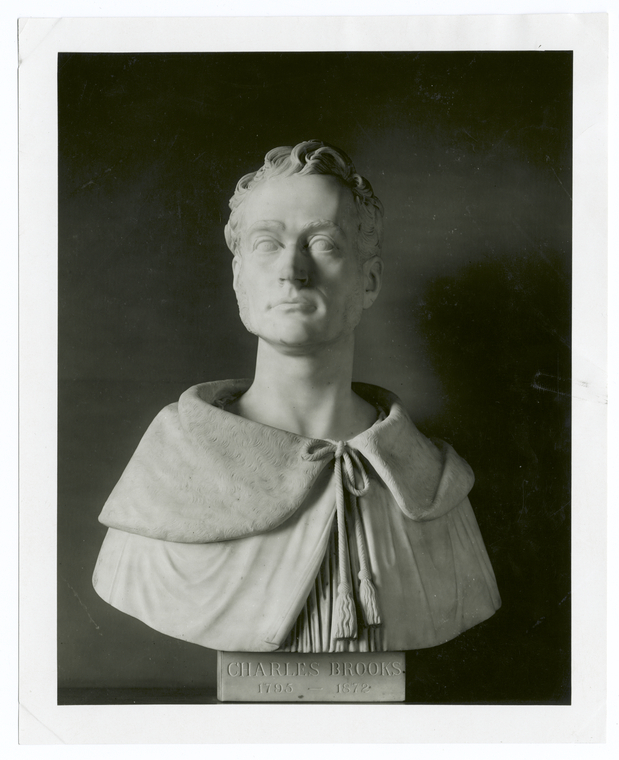
State House art, it appears that the long gone bust of education
reformer Reverend Charles Brooks – last recorded as seen in the
State Library decades ago – is in storage at the Los Angeles County
Museum of Art (LACMA). It will take attorneys and forensic wizards to
ultimately determine if the piece in question is indeed the same bust
that belongs to Massachusetts. Still we've done some digging and the
evidence is quite compelling.
According
to the 1924 State House Guide Book, a bust of Brooks –
sculpted in Rome by Thomas Crawford – was received by the
commonwealth in 1892, “conforming to the wishes of his family.”
That is confirmed in the 1907 book by John Albree, Charles Brooks
and His Work for Normal Schools, which also notes that “it has
been placed appropriately in the office of the Slate Board of
Education, Massachusetts State House.”

The
bust has quite the history, much of which is well-documented in a
series of letters that Crawford wrote to his subject in the 1840s.
While the item is often dated 1842, the correspondence shows that
while Brooks and Crawford began negotiating the cost that year, the
artist was still working on the sculpture in 1843. “I am at present
completing your bust – and hope to have it ready for a ship that is
expected at [the Italian port city] Leghorn arriving next month,”
Crawford wrote on May 19, 1843.
It's
said that when Crawford arrived in Rome from New York in 1835, he was
the first American sculptor to set up shop there. By the time he
began work on the Brooks bust, he was well-established, and in the
early 1840s had also started what would become some of his best-known
works including Orpheus and Cerberus, a Seravezza marble version of
which was first exhibited at the Boston Athenaeum, and was later
given to the Museum of Fine Arts where it remains today.

Crawford's
career was helped greatly by Massachusetts senator Charles Sumner and
George Washington Greene, who was the American consul in Rome at the
time. It was presumably through them that Crawford met Brooks, who
apparently first requested a bust of himself in 1842. Crawford quoted
the reverend $250 – his “established price” – and it appears
that he was paid $100 up front with the remainder coming years later.
The
amount due after the deposit, according to the correspondence, was
$178 – most likely $150 for the marble bust, and an additional $28
for a form cast that could be used to make duplicates. According to a
July 18, 1843 letter from Crawford, Brooks had also requested four
plaster facsimiles to be molded and shipped with the original marble
sculpture. In that same note, Crawford apologized for his tardiness
in expediting the project.
“An
unexpected delay has occurred,” he wrote, “in consequence of the
caster not having been able to [indecipherable] when he had promised
for the purpose of making the mold. I did hope and so expressed
myself an answer to your letter from Paris that the bust might leave
Rome with the statue of Orpheus and other works which were ready at
the time . . . It was only a week since that the caster could apply
himself to make the mold and he is now casting the four copies you
desire. They will require several days to dry well before it will be
possible to pack them and then all will be ready for the departure.”
The
Phoenix is unable to find proof that any of the plaster busts
were ever completed or that they arrived in America. That's not to
say that they didn't – in 1845 Crawford sent a receipt to Brooks
for a total that would have included the copies. As for which
artifact wound up at the Massachusetts State House – that's
essentially the big question. The Brooks bust in storage at the LACMA
is marble. If the one that was stolen from the commonwealth was also
marble, then it's a match.

Besides
there being no trace of plaster Brooks busts anywhere, the best proof
that the sculpture in Los Angeles came from the State House seems to
be an auction record dating back to 1992. Though it's unknown who the
seller and buyer were, a marble bust of Brooks – perfectly
resembling the item in question – was auctioned off by the Massachusetts-based Grogan & Company for $6000 on December 9,
1992. The next year, a marble bust of Brooks was donated to the LACMA
by a Mr. and Mrs. Herbert M. Gelfand. In comparing an image of the
work from LACMA's catalogue to a photo from the 1920s that was taken
at the State House, they appear to be identical – both with
distinct marble characteristics right down to a signature spot on the
lower right of the year “1795” on the base.
A
spokesperson for the commonwealth says that State House art
collections manager Susan Greendyke does not believe that the state's
bust is the same one that's in Los Angeles. Nevertheless, curators in
the American Art department at LACMA are working on the case, and
plan on bringing the piece out of storage for further examination. If
it does indeed belong to the Bay State, then hopefully measures will
be taken on all sides to ensure its safe return. Otherwise, the
search continues . . .




 Latest Slideshows